

Blue Laser vs. Fiber Laser: A New Blue Ocean Market?
What is a Blue Laser?
Blue lasers refer to lasers with a wavelength range of 400 nm to 500 nm and emit blue light. Blue lasers possess characteristics such as short wavelength, low diffraction effect, high beam quality, and high energy density, making them highly applicable in laser material processing, precision manufacturing, industrial laser applications, laser engraving, laser cutting, micro-machining, optical data storage, display technology, communication systems, and laser medical devices. These solid-state laser systems and semiconductor laser sources are increasingly used in high-precision engraving, metal surface treatment, and advanced photonics engineering.

Advantages of Blue Lasers
A shorter wavelength implies higher photon energy, which enhances the material's absorption rate of the laser. As shown in the figure, compared to the fiber lasers commonly used in industrial laser processing, the absorption rate of metal materials at 450nm increases by 10–60%, especially for high-reflectance metals like copper and gold. This improved laser absorption efficiency directly benefits metal engraving, laser welding, and surface marking applications. The energy consumption required for welding copper with blue lasers is 84% lower than that of infrared lasers, and even lower by 92% for gold. This means that while infrared lasers require 10 kW of laser power to weld copper or gold, blue lasers only need about 1 kW or 0.5 kW, making them highly efficient for energy-saving manufacturing, high-speed production, and cost-effective laser solutions.

Blue laser performance advantages stem from fundamental physical principles
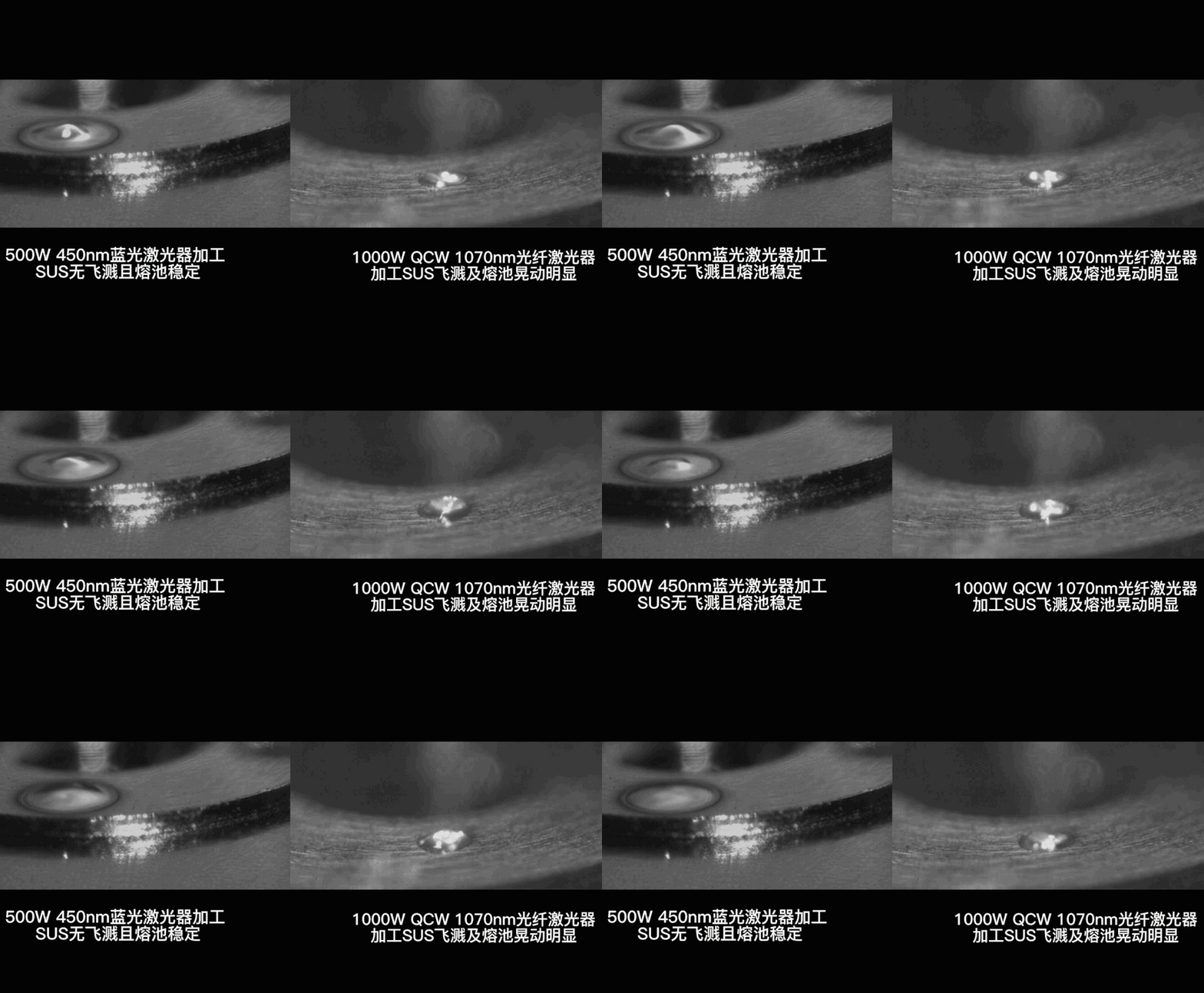
Comparison of blue light laser and fiber laser welding
Blue laser performance advantages stem from fundamental physical principles, including reduced thermal distortion, improved heat management, and superior beam absorption characteristics. These advantages make blue lasers ideal for fine engraving, micro welding, and high-contrast marking on challenging materials.
Semiconductor lasers based on gallium nitride material can directly produce 450nm wavelength lasers without further frequency doubling, thus having higher energy conversion efficiency, laser stability, and system reliability. This contributes to better laser output consistency, precision control, and long-term durability in industrial laser systems.
Also, blue light absorbs less in seawater, allowing for longer transmission ranges, making it realistic to explore underwater laser processing, marine applications, and subsea material cutting. Additionally, blue light can be easily converted to white light, enabling the compact realization of LED lighting systems, laser illumination, and optical display technologies.
Overall, blue lasers increase welding speed, which directly translates to faster manufacturing throughput, improved production efficiency, and minimized machine downtime. The consistency in welding quality significantly improves the production yield; the unique advantages of high-quality welds without spatter and porosity, higher mechanical strength, and lower electrical resistance broaden the range of industrial laser applications. Moreover, blue lasers can perform conduction welding mode, which is unachievable by near-infrared lasers, expanding their role in advanced fabrication techniques.
Development of Blue Lasers
Red and green lasers are widely used and have been industrialized for a long time in laser engraving machines, laser cutters, and consumer laser devices. In contrast, blue lasers, affected by materials, cost, and technology, started later and have developed more slowly within the laser technology market.
In 2015, the German semiconductor laser manufacturer DILAS launched a 450nm blue semiconductor laser system with a maximum output power of 25W, using fiber core diameters of 200μm or 400μm, expandable to 100W for material processing applications such as laser engraving, laser marking, and precision cutting. In the same year, Shimadzu Corporation announced the successful development of a fiber-coupled high-brightness blue direct diode laser "BLUE IMPACT," using blue gallium nitride semiconductor lasers, the world's first commercialized laser source for industrial laser processing and high-precision manufacturing.
Early blue lasers had low power and were not directly used in industrial processing, receiving little attention in the laser engraver market and laser equipment industry. However, in recent years, as blue TO package single-tube marketization, price reduction, power increase, and various fiber laser coupling technologies, beam shaping techniques, and laser diode advancements continue to evolve, the feasibility of developing high-power blue lasers has been realized. For example, the German company Laserline achieved 2000W output using beam shaping technology and fiber-coupled laser systems, while the American company NUBURU achieved 1500W output using dense spectral beam combining. The domestic company Lianying also launched a 1000W blue laser, further advancing the laser manufacturing ecosystem. The laser mentioned in the video above was launched by Kepler in January 2021, a blue 1000W product designed for industrial welding, laser cutting, and metal engraving applications.
To enhance the reliability of kilowatt-level blue semiconductor light source systems, match automated coupling and alignment equipment, and compact product structure, Kepler used fiber combiners for power expansion. Moreover, each single module used for fiber combining contains multiple sub-units. Since blue laser chips are extremely sensitive to environmental conditions, to prolong the life of blue laser products, Kepler treated each sub-unit specially, effectively ensuring long-term laser durability, thermal stability, and system reliability.
Kepler's unique packaging technology ensures the blue laser engraver products have high power stability, long life, and good reliability, making them suitable for industrial engraving machines, laser cutting systems, and precision marking equipment.
Besides the special chip protection design, Kepler's blue laser sub-units also feature a compact optical path design, beneficial for shortening the light path and enhancing the energy proportion within 0.15/0.22NA during fiber-coupled output, ensuring higher power enters finer fibers. This improves overall beam quality, laser focus precision, and engraving accuracy, which are critical for detailed laser engraving, fine metal marking, and micro fabrication processes.
From the video mentioned above, we can observe that the welding process produces stable, bright weld surfaces without any spatter; under a 40X microscope, no porosity was found inside the weld. This demonstrates the superior laser welding quality, material bonding strength, and defect-free processing capability of blue laser systems.
As technology matures, the demand for high-brightness blue light sources in future high-end manufacturing, smart factories, automated production lines, and precision engineering industries will be considerable and play a vital role. Kepler will continue to delve deep, providing customers with professional, high-quality services and advanced, reliable products, tirelessly striving to promote the development of the global laser industry, laser engraver innovation, and next-generation laser technology solutions.
Free SVG & Gcode Files for Laser Engraving & Cutting can be found here, wich you can import into our laser cutters directly.


